
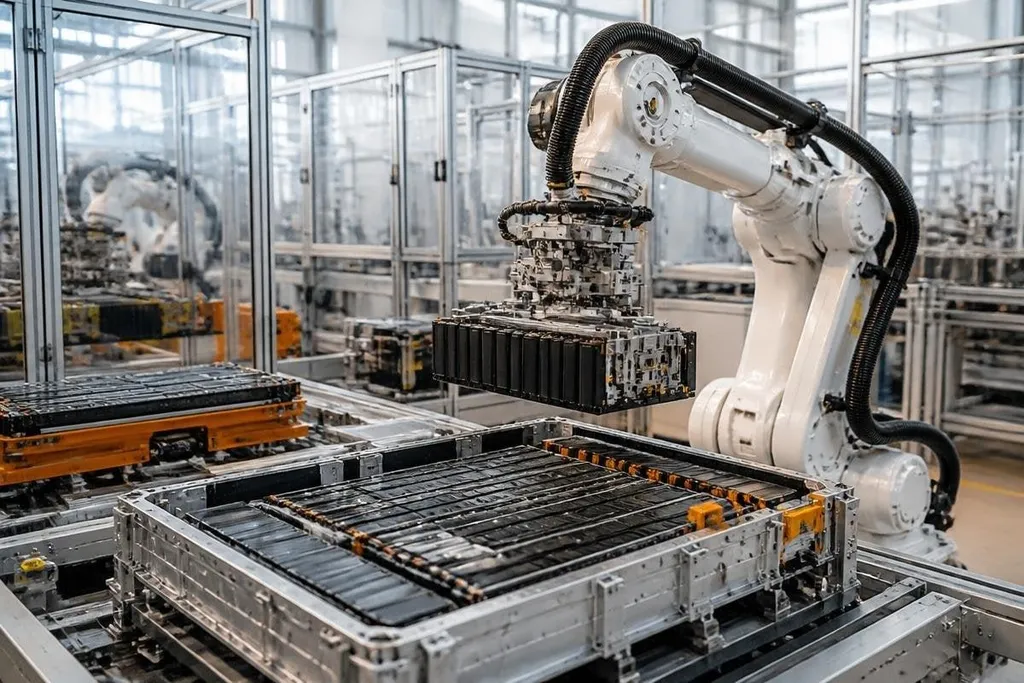
Battery production links raw materials, cell manufacturing, module assembly, pack building, and recycling. Robots can move work between these stages, repeat delicate tasks, and check parts before a fault reaches the next step.
Quick read
- Robots handle cells and modules without adding dirt or skin oils.
- Vision systems check welds, labels, gaps, and surface damage.
- The hard part is linking robot work to traceable quality records.
From cell handling to pack assembly
A battery cell is the basic energy unit. Cells are grouped into modules, and modules are joined into a pack with cooling parts, wiring, sensors, and a protective case.
That structure gives robots several jobs. A robot arm can pick cells from a tray, place them in a fixture, apply adhesive, or position busbars. A busbar is the metal link that carries current between cells.
The robot repeats the same path while a camera checks whether each part sits in the right place. The work needs care. A dented cell, a loose connection, or a misplaced insulator can create trouble later. Robots reduce variation in these steps, but they don't decide whether an unusual part is safe unless the inspection system has rules for it.
Pack assembly adds heavier parts and tighter access. Robots may place modules in a case, route cables, fit covers, and tighten fasteners to a set torque. Torque is the turning force applied to a bolt. Recording that value gives the production team a trace of how the pack was built.
Inspection is where the data matters
Inspection robots can move a camera, probe, or scanner around a cell or pack. The inspection may check a weld, a connector, a label, or the gap between parts. Each check has value only when the result is tied to the correct battery and production step.
That link is called traceability. It lets a team connect a failed pack with the cells, parts, tools, and inspection results used to build it. Without that record, a robot may complete thousands of identical motions while the cause of a fault stays unclear.
Robot arms also support electrical checks. A test station can connect to a battery, measure its response, and send the result to the production system. The robot's job is to place and remove the connector in the same way each time. The test equipment still decides what the reading means.
Factory teams tracking the move from electrical checks to material handling can use Robot24.com robotics coverage to compare named machines with reported results. The next section looks at why warehouse and recycling work call for different robot designs.
Warehouses and recycling need different robots
Battery warehouses ask for movement rather than assembly. Mobile robots can carry cells, modules, or finished packs between storage areas and workstations. Their software must know where each load belongs, how much it weighs, and which handling rules apply.
That last point matters because battery packs can store a large amount of energy. A warehouse system needs clear rules for damaged parts, charging areas, temperature checks, and emergency access. A mobile robot that reaches the wrong area quickly has completed the wrong task.
Recycling brings another set of jobs. Robots can sort parts, remove covers, separate materials, or handle packs during disassembly. Pack designs vary, so a fixed motion may work for one model and damage another. Cameras, part records, and operator checks become more useful as the mix of packs grows.
The open limit is judgment. Robots repeat known actions well, but unusual damage, wet parts, missing labels, and altered pack designs can defeat a system built around normal inputs.
What to check before buying
A factory team choosing a robotic system should check these points before comparing arm speed or payload:
- Name the task: write down the part, position, cycle time, and handoff the robot must complete.
- Set the evidence: decide which camera images, torque readings, electrical results, and operator checks need storage.
- Test the bad parts: include bent tabs, missing labels, poor welds, and parts outside normal size.
- Check access: leave room for maintenance, emergency stops, inspection, and safe removal of a damaged pack.
- Plan the changeover: confirm how the system will handle a new cell format, module design, or pack case.
- Price the whole cell: include grippers, fixtures, cameras, software, training, service, and downtime during setup.
The best fit depends on the task. A robot arm may suit repeated module assembly, while a mobile robot may suit movement between stations. I'd skip any system that shows smooth handling but gives no clear record for failed parts.
Battery robotics will grow through practical links between movement, inspection, testing, and factory records. The next useful proof is not another staged pick; it's a production line that can explain which part failed, when it failed, and what the team did next.